Kuyenda Pang’onopang’ono: Madzulo a $100 pa Zofiira
A $100 starting balance, $5 on red and two stop limits. Follow a constructed sequence that reaches the loss limit on spin 36.

Madzulo oyerekezedwa pa tebulo la pompopompo: mpaka mazungulidwe 60 a $5 pa zofiira kuchokera pa bajeti ya $100, ndi malire otaya a $50 ndi malire a phindu a $50. Malire otaya anathetsa gawoli pa kuzungulira 36. Gawoli likusonyeza momwe kusinthasintha kumaonekera panthawi yeniyeni ndi chifukwa chake lamulo losiya ndilo chisankho chokhacho chimene chinali chofunika.
Dongosolo
Use a standard single-zerogudumuZiroKabowo kamodzi kobiriwira kamene betcha la even-money, dazeni kapena mzati siliphimba; gwero la phindu la kasino. Imatchedwanso: ziro imodzi, 0.Werengani yonse → wheel. Start with $100, stake $5 on redbetchaZofiiraBetcha la even-money pa manambala 18 ofiira. Mu Chifalansa: rouge.Werengani yonse →, and stop at a $50 or $150 balance, or after sixty spins, whichever comes first. These are illustrative settings, not a claim that $100 or $5 is suitable for every player. At exactly sixty fixed-stake spins, expected lossmasamuKutayika koyembekezekaMtengo woyembekezeka kuchulukitsa ndi ndalama zonse zobetchedwa; kuchuluka kwapakati kwa ndalama zotayika mu gawo la masewera kapena nthawi inayake.Werengani yonse → would be $300/37, about $8.11. A rule that can stop earlier has a different expected number of spins.
Mazungulidwe 1–20
The first twenty chosen results are R B B R R 0 B R R B R B B B R R B R B R. Ten reds, nine blacksbetchaZakudaBetcha la even-money pa manambala 18 akuda. Mu Chifalansa: noir.Werengani yonse → and one zero leave the balance at $100. Zero at spin 6 is neither early nor late in a predictive sense: each spin has the same 1/37 chance of zero.
Mazungulidwe 21–36
The next sixteen results are B B B B B R B B R B B R B B B B. Three reds and thirteen blacks lose $50. The balance first reaches the $50 stop-lossnjiraMalire otayaKuchuluka kwa kutaya kosankhidwa pasadakhale kumene mumathetsera gawo la masewera.Werengani yonse → at spin 36. We stop there. This worked example does not claim that a live table takes a particular amount of time to deal those spins.

Mazungulidwe 37–60, popanda ife
The ledger totals $180 wagered and −$50 net, leaving $50 from a $100 starting balance. At each spin, the expected loss under these standard single-zero rules is the stake divided by 37. Because later bets or stopping can depend on earlier results, expected session loss depends on expected total turnoverndalamaNdalama zonse zobetchedwaNdalama zonse zobetchedwa mu gawo la masewera kapena nthawi inayake, kuphatikizapo ndalama zopambana zobetchedwanso. Zimatchedwanso: handle, action.Werengani yonse →. A single worked sequence does not establish the average session result.
Zimene zinachitika
The realized loss is $50. It is not a fixed admission price plus a separately charged luck fee. At each placed $5 bet, the expected loss was $5/37; the actual result could be +$5 or −$5. Stopping can reduce expected turnover. It does not make any future red more or less likely.
Mafunso
Machipi makumi awiri m’manja m’malo mwa khumi. Madzulo amatalika; mtengo pa kuzungulira kulikonse umachepa ndi theka.
On a French even-money betbetchaBetcha la even-moneyZofiira/zakuda, osakhala awiriawiri/awiriawiri, okwera/otsika. Manambala 18, amalipira 1:1.Werengani yonse →, zero loses half the stake. For exactly sixty $5 bets, expected loss is $300/74, about $4.05. With stop rules, the changed payoutsndalamaMalipiroZimene betcha lopambana limabweza, zotchulidwa ngati “X ku 1” kuwonjezera pa ndalama zobetcha zobwezedwa.Werengani yonse → can also change when you stop.
About 0.7975% for a particular sixteen-spin block on a fair single-zero wheel. It is not the probabilitymasamuKuthekeraMwayi wa zotsatira, kuchokera 0 mpaka 1 kapena 0% mpaka 100%. Nambala imodzi: 1/37 = 2.70%.Werengani yonse → of seeing such a block somewhere during an entire evening.
Nthabwala yopumitsa
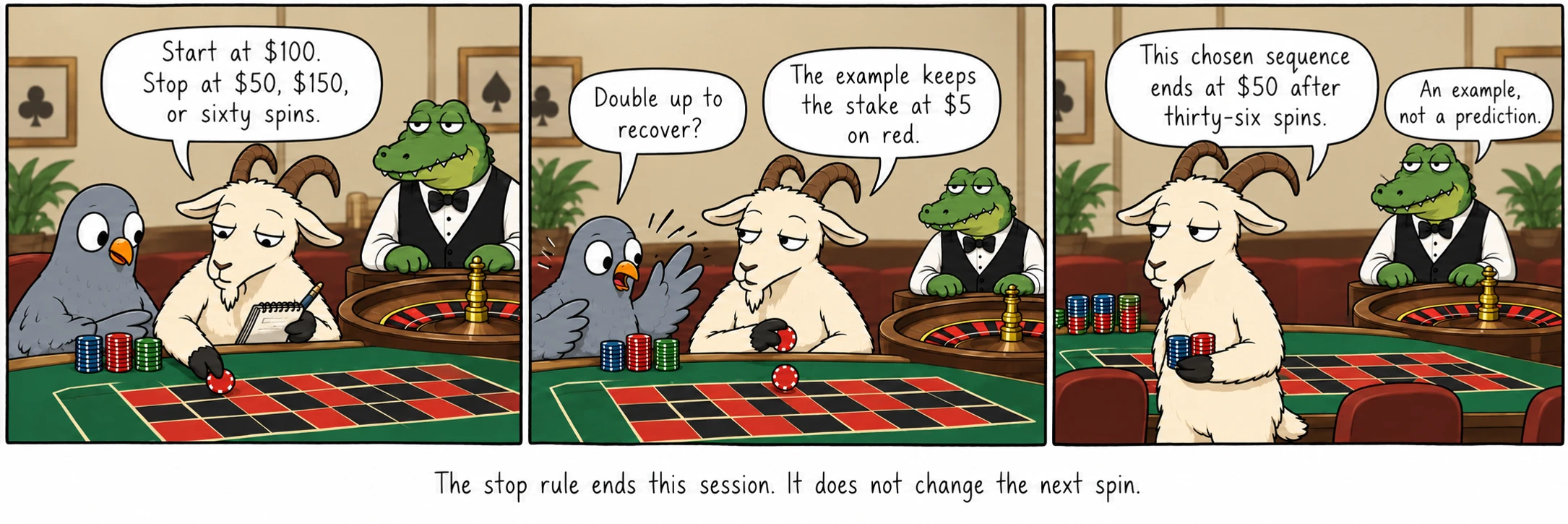
Ndalama zobetcha ndi mazungulidwe zimakhazikitsa mtengo. Gudumu linakhazikitsa mtima.
Magwero
- Ethier, S. N. The Doctrine of Chances: Probabilistic Aspects of Gambling.