Vuto: Malire a Tebulo
Martingale ya $10 pa tebulo la $500. Kodi imasweka kangati, imataya zingati ikasweka, ndipo kodi kukweza malire kumathandiza?
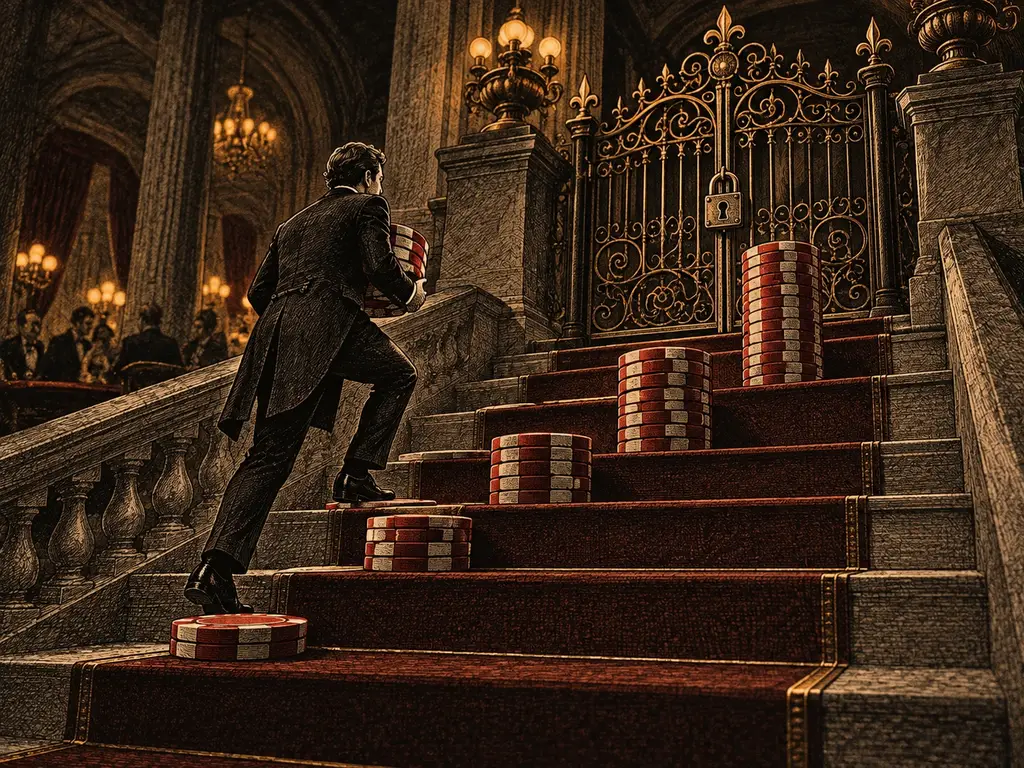
Kuluza kasanu ndi kamodzi motsatizana kumaiswa: 1.8% pa cycle iliyonse, pafupifupi 60% ya magawo a kuzungulira 100. Kusweka kumadula $630. Kukweza malire kufika $5,000 kumapangitsa kusweka kukhala kosowa (0.25% pa cycle) ndi kwakukulu ($5,110). Kutayika koyembekezeka pa dola iliyonse yobetchedwa ndi 2.70% pa malire aliwonse.
Vuto
Assume independent spinsmasamuKuzungulira kodziyimira payokhaKuzungulira kulikonse kuli ndi kuthekera kofanana mosasamala kanthu za mbiri. Maziko a kuwerengera kulikonse pa tsamba lino.Werengani yonse → and standard single-zerogudumuZiroKabowo kamodzi kobiriwira kamene betcha la even-money, dazeni kapena mzati siliphimba; gwero la phindu la kasino. Imatchedwanso: ziro imodzi, 0.Werengani yonse → payoutsndalamaMalipiroZimene betcha lopambana limabweza, zotchulidwa ngati “X ku 1” kuwonjezera pa ndalama zobetcha zobwezedwa.Werengani yonse →, with enough bankrollndalamaNdalama zosewereraNdalama zonse zimene mwazisiyira masewera. Kusamalira ndalama zosewerera ndiko kusankha kuchuluka kwake komwe mungaike pachiopsezo pa betcha lililonse ndi pa gawo lililonse la masewera.Werengani yonse → to fund each permitted stake. A player bets $10 on redbetchaZofiiraBetcha la even-money pa manambala 18 ofiira. Mu Chifalansa: rouge.Werengani yonse → and doubles after each loss, resetting after a win. The table maximum is $500. (a) How many consecutive losses break the progressionnjiraProgressionLamulo lililonse limene limasintha ndalama zobetcha potengera zotsatira zakale. Maprogression olakwika amazikweza pambuyo poluza, abwino pambuyo popambana.Werengani yonse →? (b) What is the probabilitymasamuKuthekeraMwayi wa zotsatira, kuchokera 0 mpaka 1 kapena 0% mpaka 100%. Nambala imodzi: 1/37 = 2.70%.Werengani yonse → per cycle? (c) What is lost at the break? (d) How does a $5,000 limit change the answers? (e) Does any limit make the system profitable?
Mayankho (a)–(c)
Ndalama zobetcha: 10, 20, 40, 80, 160, 320. Yachisanu ndi chiwiri ikanakhala 640 > 500, choncho kuluza kasanu ndi kamodzi kumaiswa. (b) p(kuluza) = 19/37 pa zofiira; (19/37)⁶ = 0.0183, pafupifupi 1.8% pa cycle iliyonse. Cycle imakhalitsa pafupifupi kuzungulira kawiri pa avareji, choncho gawo la kuzungulira 100 lili ndi pafupifupi ma cycle 50 ndipo p(kusweka kamodzi pang’ono) ≈ 1 − 0.9817⁵⁰ ≈ 60%. (c) 10 + 20 + 40 + 80 + 160 + 320 = $630, zimene ndi ma unitndalamaUnitNdalama zobetcha zoyambira zimene dongosolo kapena wosewera amagwiritsa ntchito. Maprogression amafotokozedwa mu ma unit kuti agwire ntchito pa tebulo lililonse.Werengani yonse → a maziko 63, poyerekeza ndi $10 imene cycle inali kuyesa kupambana.
Yankho (d)
At $5,000: stakes to 2,560 are allowed; the tenth stake, 5,120, is refused. Nine losses break it: (19/37)⁹ ≈ 0.25% per cycle, about 11% of 100-spin sessions. Loss at the break: 10 + 20 + … + 2,560 = $5,110. The player has bought a rarer catastrophe at the price of a larger one. Over many sessions the expected cost of breaks is p × loss ≈ 0.0183 × 630 = $11.5 per cycle at the $500 limit and 0.0025 × 5,110 = $12.8 at $5,000; each is the expected contribution from failed cycles. Subtract the expected profit from successful cycles, $10 × (1 − p), to obtain total expected lossmasamuKutayika koyembekezekaMtengo woyembekezeka kuchulukitsa ndi ndalama zonse zobetchedwa; kuchuluka kwapakati kwa ndalama zotayika mu gawo la masewera kapena nthawi inayake.Werengani yonse → per cycle: about $1.74 and $2.71 respectively.
Yankho (e)
With a finite limit and a well-defined stopping rule, expected loss equals expected turnoverndalamaNdalama zonse zobetchedwaNdalama zonse zobetchedwa mu gawo la masewera kapena nthawi inayake, kuphatikizapo ndalama zopambana zobetchedwanso. Zimatchedwanso: handle, action.Werengani yonse → divided by 37. Changing the limit can change turnover substantially. For the 100-spin examples below, the player resets to $10 after either a win or a failed progression, and has enough money to place every bet. These are exact model expectations, not a simulation. The imaginary unlimited-bankroll, unlimited-stake MartingalenjiraMartingaleProgression yowirikiza betcha pambuyo poluza kulikonse. Onani gawo la Njira kuti mudziwe zimene imachita ndi zimene siimachita.Werengani yonse → is different: a single cycle eventually wins $10 with probability 1, but its expected turnover is infinite. The finite-expectation identity cannot be applied to that unbounded stopping problem. Real bankrolls and tables cannot implement it.
Matebulo awiri enieni
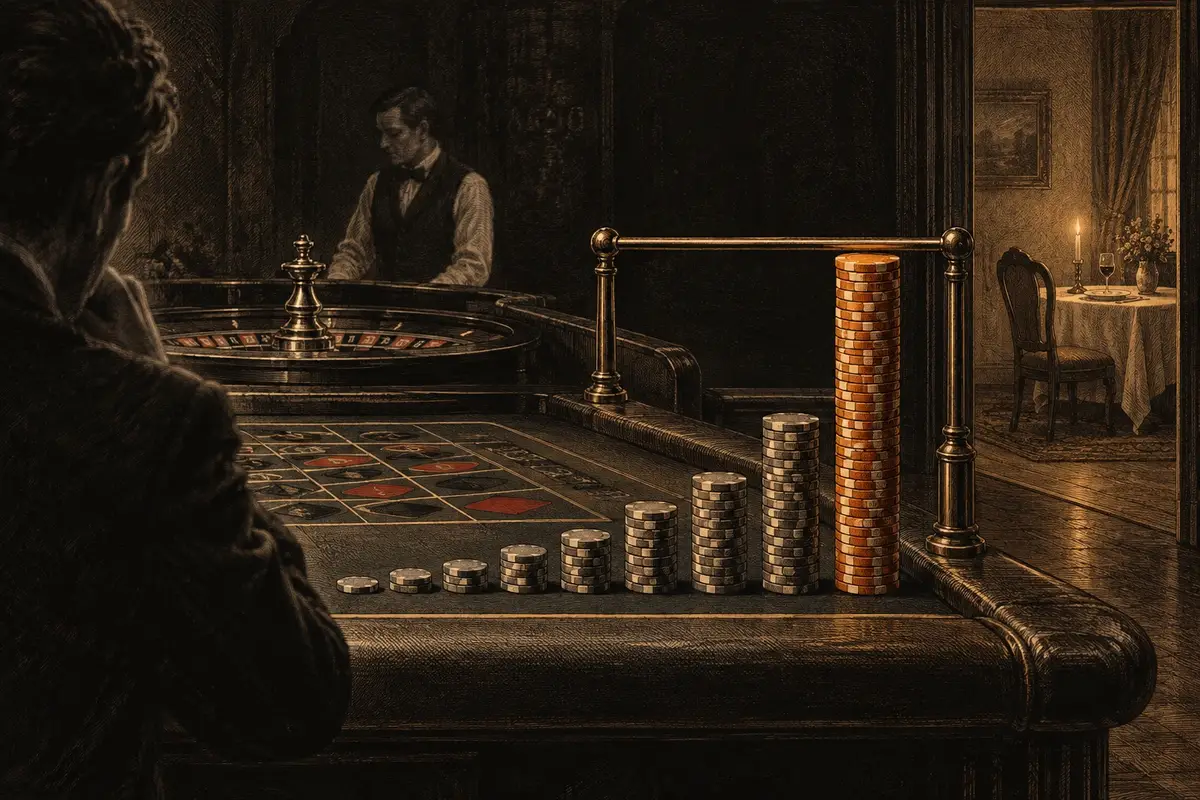
Chitsanzo cha Thorp ndi tebulo la $1 lokhala ndi malire apamwamba a $1,000, pamene wosewera akuyembekeza kupambana $30 ya chakudya chamadzulo dola imodzi nthawi iliyonse. Ndalama zobetcha 1, 2, 4 … 512 zimalola mabetcha khumi, choncho kuluza kakhumi motsatizana kumaswa progression: kamodzi pa ma cycle 785 pa gudumu la ku Ulaya (kamodzi pa 613 pa la ku America), pa mtengo wa $1,023. Ma cycle makumi atatu onse amapambana 96.2% ya nthawi. Ena 3.8% amataya pafupifupi $1,000, ndipo zotsatira za avareji za madzulo ndi −$9.17, zimene ndi ndendende 1/37 ya $339 imene ma cycle makumi atatu amabetcha pa avareji. Tebulo la $5 lokhala ndi malire apamwamba a $2,000 si losiyana: ndalama zobetcha mpaka $1,280 zimalola mabetcha asanu ndi anayi, ndipo kusweka kumabwera kamodzi pa ma cycle 403 pa gudumu la ku Ulaya (kamodzi pa 323 pa la ku America) ndipo kumadula $2,555.
Wosewera wolemera
The table maximum is only one constraint. The player may run out of money before reaching it. A simulation must state whether it stops, resets to the base stake or bets the remaining balance when the next double is unaffordable. Those choices change session probabilities, so results from one rule cannot describe every Martingale strategy.
Phunziro
A higher limit permits rarer but larger failed progressions. It does not remove the negative expectation of each standard bet, and it may increase the amount wagered. Compare the total exposure and stopping rule as well as the chance of a short winning cycle.
Fomula
Mafunso
Zimakuthandizani kupulumuka mpaka malire okwera, kumene kusweka kumakhala kosowa ndi kwakukulu. Kutayika koyembekezeka pa dola iliyonse sikusintha.
Ndalama zobetcha 10, 30, 70, 150, 310: malire a $500 amafikiridwa pambuyo pa kuluza kasanu, ndipo kusweka kumadula $570. 2.70% yomweyo.
A maximum limits the payout exposure accepted on a bet. The operator sets the actual limits; their existence does not create roulette’s house edgemasamuPhindu la kasinoGawo la ndalama zobetcha zilizonse limene kasino imasunga pa avareji: 2.70% mu roulette ya ku Ulaya.Werengani yonse →.
Masamu Osangalatsa
Yesani nokha choyamba. Yankho lililonse labisika; litsegulireni mukakonzeka.
A MartingalenjiraMartingaleProgression yowirikiza betcha pambuyo poluza kulikonse. Onani gawo la Njira kuti mudziwe zimene imachita ndi zimene siimachita.Werengani yonse → starts at $100 on redbetchaZofiiraBetcha la even-money pa manambala 18 ofiira. Mu Chifalansa: rouge.Werengani yonse → and allows itself at most n bets a cycle: after n losses in a row it gives up and starts again. Write the average result of one cycle as a formula in n, and work it out for 5, 6 and 7 bets on a European wheel. Assume independent uniform single-zerogudumuZiroKabowo kamodzi kobiriwira kamene betcha la even-money, dazeni kapena mzati siliphimba; gwero la phindu la kasino. Imatchedwanso: ziro imodzi, 0.Werengani yonse → results and sufficient funds for every permitted stake.
Onetsani yankho
Yankho Avareji ndi 100 × (1 − (38/37)ⁿ): −$14.26 pa mabetcha 5, −$17.35 pa 6 ndi −$20.52 pa 7. Kulola mabetcha ochuluka kumapangitsa cycle ya avareji kukhala yoipa kwambiri, osati yabwino.
A cycle wins $100 unless all n bets lose, which happens with chance qⁿ, where q = 19/37. When they all lose, the stakes 100, 200 … 100 × 2ⁿ⁻¹ add up to 100 × (2ⁿ − 1). So the average is 100 × (1 − qⁿ) − 100 × (2ⁿ − 1) × qⁿ = 100 × (1 − (2q)ⁿ).
Here 2q = 38/37, a little more than 1, so (2q)ⁿ grows with n and the average falls: n = 5 gives 1.1426 and −$14.26; n = 6 gives 1.1735 and −$17.35; n = 7 gives 1.2052 and −$20.52. A longer ladder loses less often, in 3.6%, 1.8% and 0.9% of cycles, but each loss is twice as large, and more money crosses the table each cycle, at 2.70% of every bet.
On an American wheel 2q = 40/38 and the figures are −$29.24, −$36.04 and −$43.20. In a game with no zero 2q = 1, and every cycle averages exactly zero however long the ladder.
“Grand Martingale” imawirikiza kawiri ndalama zobetcha pambuyo pa kuluza ndipo imaonjezera unitndalamaUnitNdalama zobetcha zoyambira zimene dongosolo kapena wosewera amagwiritsa ntchito. Maprogression amafotokozedwa mu ma unit kuti agwire ntchito pa tebulo lililonse.Werengani yonse → imodzi, choncho ndalama zobetcha zimayenda 1, 3, 7, 15, 31 … Muli patsogolo ndi zingati pamene kupambana koyamba kwabwera pa betcha la 1, la 2, la 3 kapena la k? Ndi unit ya $10 ndi malire a m’mwamba a $500, cycle imasweka kangati, ndipo cycle imawononga zingati pa avareji?
Onetsani yankho
Yankho Kupambana pa betcha la k kumakusiyani patsogolo ndi ma unit k: +1, +2, +3 ndi zina zotero. Pa $10 ndi $500 cycle imasweka pambuyo pa kuluza kasanu, 3.57% ya ma cycle, kutaya −$570. Pa avareji cycle imataya $2.32 mwa $85.73 yobetchedwa: 2.70%.
The kth stake is 2ᵏ − 1 units: 1, 3, 7, 15, 31. The first k − 1 stakes add up to 2ᵏ − 2 − (k − 1) = 2ᵏ − k − 1. A win on the kth bet pays 2ᵏ − 1, so the cycle ends (2ᵏ − 1) − (2ᵏ − k − 1) = k units up: one extra unit for every loss before the win.
At least $570 is needed to fund all five stakes in a fresh cycle. At $10 a unit the stakes are $10, $30, $70, $150 and $310; the next, $630, is over the $500 maximum. Five losses in a row, (19/37)⁵ = 3.57%, cost 10 + 30 + 70 + 150 + 310 = $570.
Average: the wins bring in $10 × k with chance (19/37)ᵏ⁻¹ × 18/37 for k = 1 to 5, and the break takes $570 with chance 3.57%; together −$2.32. The money staked averages $85.73 a cycle, and 2.32/85.73 = 2.70%. The ordinary Martingale at the same table breaks after six losses, 1.83% of cycles, for −$630, and loses $1.74 out of $64.20 staked: 2.70% again.
Wosewera akukonzekera Martingale pa zofiira ndi betcha loyamba la $1 patebulo limene malire ake ndi $1,000, choncho mabetcha khumi n’zotheka: $1, $2, $4 ndi zina zotero mpaka $512. Kodi cycle imataya onse khumi kangati, zimenezo zimatenga nthawi yaitali bwanji pa avareji, ndipo madzulo a mabetcha 200 amatha choncho kangati?
Onetsani yankho
Yankho Cycle imataya onse khumi pafupifupi kamodzi pa 784, zimene zimawononga $1,023. Zimenezo ndi pafupifupi mabetcha 1,600 pa avareji, ndipo madzulo a mabetcha 200 amagunda khoma pafupifupi 11% ya nthawi. Cycle imatayabe $0.31 pa avareji mwa $11.31 yobetchedwa: 2.70%.
Betcha pa zofiira limaluza ndi kuthekera kwa 19/37, kuphatikizapo ziro. Khumi motsatizana: (19/37)¹⁰ ≈ 0.00128, pafupifupi 1 pa 784. Ndalama zobetcha 1 + 2 + 4 + … + 512 pamodzi ndi $1,023.
Cycle imatenga mabetcha 2.05 pa avareji, choncho ma cycle 784 amatenga pafupifupi mabetcha 1,600. Kuwerengera kuzungulira ndi kuzungulira, zotsatizana za kuluza khumi zimapezeka kwinakwake m’mabetcha 200 11.3% ya nthawi.
Pakati pa masoka wosewera amapambana $1 pa cycle iliyonse: pafupifupi $783 cycle yoipa isanabwere, kenako −$1,023, pafupifupi −$240 pa nthawi yonseyo. Pa cycle iliyonse: 1 × (1 − 0.00128) − 1,023 × 0.00128 ≈ −$0.31. Ndalama zobetchedwa pa cycle iliyonse: 1 + 2 × (19/37) + 4 × (19/37)² + … + 512 × (19/37)⁹ ≈ $11.31. Ndipo −0.31/11.31 = −2.70%.
Yerekezerani ndi betcha loyamba la $10 pa malire a $500, mabetcha asanu ndi limodzi: khoma limabwera kamodzi pa ma cycle 55, ndipo madzulo a mabetcha 200 amakumana nalo 84% ya nthawi. Malire okwera amapangitsa kugwa kukhala kosowa komanso kwakukulu, osati kotsika mtengo.
Nthabwala yopumitsa
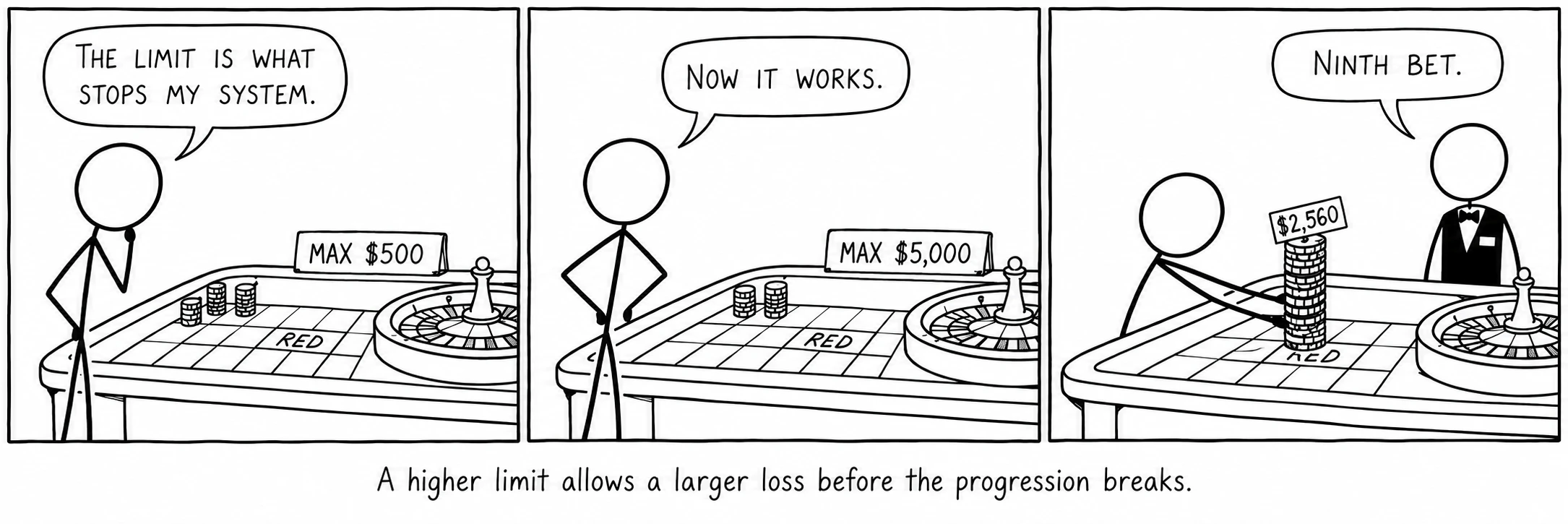
Kosowa ndi kwakukulu, pa malire aliwonse. Kuchulukitsa kwake sikusintha.
Magwero
- Ethier, S. N. The Doctrine of Chances: Probabilistic Aspects of Gambling.
- Thorp, E. O. “Optimal gambling systems for favorable games.”
- Thorp, E. O. The Mathematics of Gambling.
- Epstein, R. A. The Theory of Gambling and Statistical Logic, 2nd ed.